ERNIE 5.0 vs GPT-5 vs Claude Opus 4.7: Real Benchmark Reads
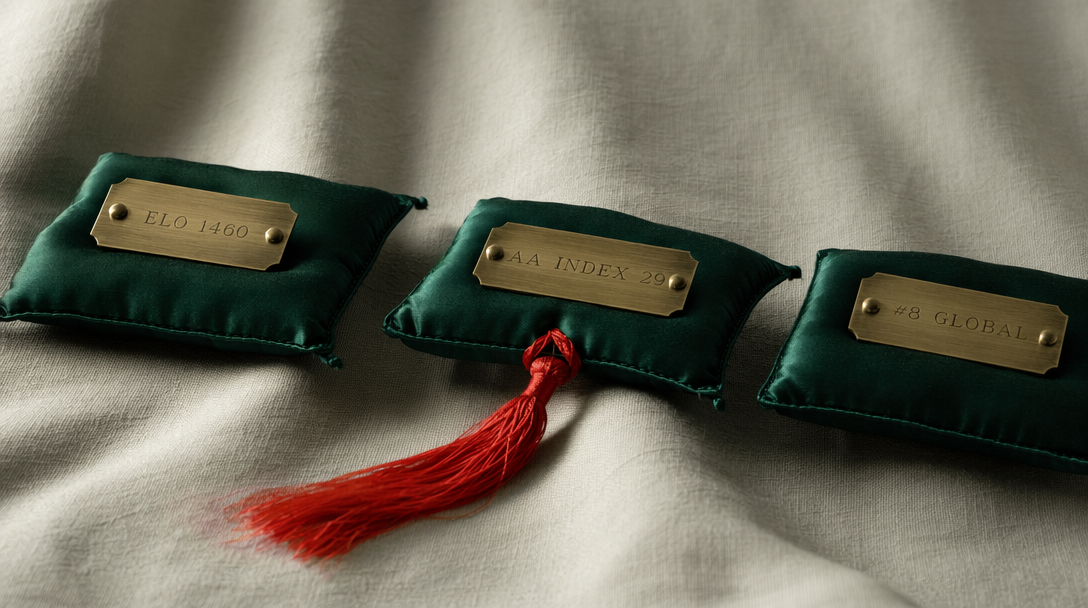
Two headline numbers tell you where ERNIE 5.0 sits: LMArena 1460 at rank 8, AA Intelligence Index 29. Here is what both actually mean for your product.
You picked up ERNIE 5.0 because you saw it top a leaderboard, and now you want to know whether it belongs in your stack next to GPT-5 and Claude Opus 4.7. This post gives you the two numbers you need, the gap between them, and the call you should make per workload.
The two scoreboards that matter
LMArena and Artificial Analysis Intelligence Index both rank language models, and they disagree about ERNIE 5.0 by a wide margin. You should look at both because they measure different things.
LMArena is a blind preference arena. Humans see two responses side by side and pick the one they like. On January 15, 2026, ERNIE 5.0 posted a 1460 Elo, which put it at rank 1 among Chinese models and rank 8 globally. That score says users reading the output preferred ERNIE 5.0 over most alternatives in direct comparison.
AA Intelligence Index is a composite of seven benchmarks covering reasoning, coding, math, and knowledge. ERNIE 5.0 sits at 29. GPT-5, Claude Opus 4.7, and Gemini 3.1 Pro all cluster at 57. That is a 28-point spread, which is the difference between a model you reach for on frontier reasoning tasks and one you reach for elsewhere.
Why the disagreement? LMArena rewards response polish, formatting, persona, and tone fit. AA Index rewards raw problem solving. ERNIE 5.0 writes very pleasing responses, especially in Chinese, and humans vote for pleasing responses when the underlying answer is roughly correct. AA Index does not care whether the response reads well. It cares whether the answer is right.
Where ERNIE 5.0 actually wins
Chinese natural language work is the clearest case. If your user base is reading, writing, or searching in Chinese, ERNIE 5.0 is a top pick. The LMArena rank 1 domestic finish is not marketing, it is thousands of head to head votes. GPT-5 and Opus 4.7 both handle Chinese, but they were not shaped around Chinese literary conventions, idioms, and rhetorical patterns the way Baidu tuned ERNIE.
Multimodal generation with typography is the second. ERNIE-Image, which shares the family branding, hits 0.9733 on LongTextBench and 0.8728 on GenEval with the enhancer enabled. Those numbers mean long strings of readable text inside generated images, which is the one thing Flux and SDXL still stumble on. If your product generates posters, product cards, or social creative in Chinese or English, ERNIE-Image is worth the slot.
Long context Chinese document synthesis is the third. ERNIE 5.0 was trained with heavy weighting on Chinese corpora, so question answering over long Chinese reports, contracts, or academic papers feels tight. You will spend fewer tokens repeating instructions.
Where it loses ground
English reasoning at the frontier. AA Index 29 vs 57 is not close. GPQA Diamond, SWE-bench Verified, and the hard math benchmarks all show ERNIE 5.0 trailing the frontier class by 20 to 30 points. If your workload is English-first reasoning over code, academic content, or multi-step logic, pick GPT-5 or Opus 4.7.
Agent loops with tools. ERNIE 5.0 does not yet have the same tool use reliability you get from Claude or GPT in agent harnesses. The chain of thought tends to break down earlier under repeated tool calls.
Coding benchmarks. SWE-bench Verified and LiveCodeBench both show wide gaps. For autonomous code edits across a repo, Opus 4.7 is in its own class and ERNIE 5.0 is not a substitute.
The routing call you should make
Build a router. Send Chinese conversational traffic to ERNIE 5.0. Send English agent traffic to Opus 4.7. Send image generation with embedded typography to ERNIE-Image. The cost asymmetry alone makes this worthwhile. ERNIE 5.0 text sits around $0.60 input and $2.10 output per 1M tokens via Qianfan, which is well under GPT-5 and Opus 4.7 list pricing.
Here is a minimal call against Qianfan using the OpenAI-compatible wrapper so you can test both sides of the router with identical client code.
01curl https://qianfan.baidubce.com/v2/chat/completions \02 -H "Authorization: Bearer $QIANFAN_API_KEY" \03 -H "Content-Type: application/json" \04 -d '{05 "model": "ernie-5.0",06 "messages": [07 {"role": "system", "content": "You are a concise assistant."},08 {"role": "user", "content": "Compare quantum annealing to gate based quantum computing in three bullets."}09 ],10 "temperature": 0.4,11 "max_tokens": 40012 }'
Wire the same payload shape to your OpenAI or Anthropic client for the routing fork. The OpenAI-compat wrapper lets you keep one SDK across both sides.
Read before you pick
Treat LMArena as a proxy for user satisfaction on short to mid answers, and AA Index as a proxy for correctness on hard tasks. ERNIE 5.0 is the right tool when the first matters more than the second, which is a larger slice of real product work than the frontier race implies. Put your Chinese traffic on ERNIE, put your English reasoning on GPT-5 or Opus 4.7, and use ERNIE-Image for the typography-heavy image jobs where it quietly leads.